

12 Ohms implies 16 ohm frams. Description is not at issue, they look the same.
I suspect your diaphragms have been replaced.
Part numbers will tell the story if you can find them, GPA should be able to cross reference.


Hello guys,
I checked the archives but decided to post my question here as well. I got a great deal with a pair of 288C($300). It says "24 Ohms" on both but measures 12 ohms DCR. Does that mean it's a 16 ohm diaphragm? The diaphragms are "channeled" type that says "Altec Lansing Corp" embossed on the plastic rim and an "L1" white mark for phase designation, not the typical original ones(tall lip) where you can see "L1" as well.
Thank you!
Abe
QNME In Retro!


12 Ohms implies 16 ohm frams. Description is not at issue, they look the same.
I suspect your diaphragms have been replaced.
Part numbers will tell the story if you can find them, GPA should be able to cross reference.
Your neighbors called. They like your music.

I concur. The 16 ohm 'frams I have measure 12 ohm DCR.
Thank you guys! It is a 16 ohm diaphragms then. I have to change the XO that I built. Again, thanks much for the info. Regards,
Abe
QNME In Retro!
16 ohms is nominal. Mine peak as high as 60 ohms between about 200-500Hz. I use 2.2R series and 20R parallel to tame that impedance curve. Much more attenuation when running passive.
11R series and 6R parallel with bring you down 10dB with a nice flat impedance around 16 ohms.
Impedance at crossover point is what's most important, at least in my sometimes humble opinion.
12 Ohms is DC (direct current-your meter runs on a battery) resistance...do NOT confuse that with impedance. Impedance is frequency dependent, and DC has no frequency, or zero frequency might be a better choice of words. So no how, no way, do they measure 12 ohms impedance. Then again, technically they do at zero Hz.
It's fairly typical for DC resistance to be around 70-75% of the "nominal" impedance. 8 ohm IMPEDANCE woofs will often show between 5-6 ohms RESISTANCE.
Since impedance is frequency dependent, you can measure it at different frequencies with devices designed to do so, and plot the results on a graph called an "impedance curve"
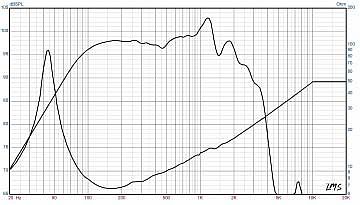
Here is a graph showing two curves for a live sound woofer in a sealed test box.
Top curve is frequency response, bottom curve is impedance. You can clearly see the impedance varying with frequency.
Since there has to be a rating, a "nominal" impedance is specified. Manufacturers vary on what "nominal" means.
One place junior pro sound engineers get in trouble is confusing the two (resistance and impedance).
Two 8 ohm speakers is 4 ohms right? Except if they drop to two ohms at some point in the curve, you have a 1 ohm load on your amp at that frequency. Said junior engineer will then wonder why his amps are going into thermal protect.
Assuming they aren't clipping to the point he is frying his speakers, and maybe amp.
Your neighbors called. They like your music.

Abe, I was wondering the same thing. All of my 288C drivers measure around 12 ohms DCR, including a pair of new old stock 20221 Altec replacement diaphragms identified as 24 ohms on the boxes. The 16 ohm 288D drivers all measured around 7 ohms, also non-typical by today's standards... The new in box frams are the channel type like you described, with push on terminals. The diaphragms inside the speakers are the taller solid type with screw terminals, that I believe are original. I'm guessing that your diaphragms are "24 ohm".
Model Label DCR
288C 24 ohms 11.4
288C 24 ohms 11.7
288C 24 ohms 11.8
288C 24 ohms 12.3
288C 24 ohms 12.3
288C 24 ohms 12.1
288C 24 ohms 12.4
288D 16 ohms 8.2
288D 16 ohms 6.9
288D 16 ohms 7.1
288D 16 ohms 7.5
20221 24 ohms 12.8
20221 24 ohms 12.5
Impedance should be measured to design crossovers. Plugging in a textbook value gives you a textbook, not custom, crossover. If they are measured DC resistance just plain don't count.
Your neighbors called. They like your music.
Thanks for the info! Sorry for the very very late reply!Originally Posted by jpg

regards,
Abe
QNME In Retro!
 Posting Permissions
Bookmarks